Safeswim

Safeswim: monitoring water quality to reduce health risk

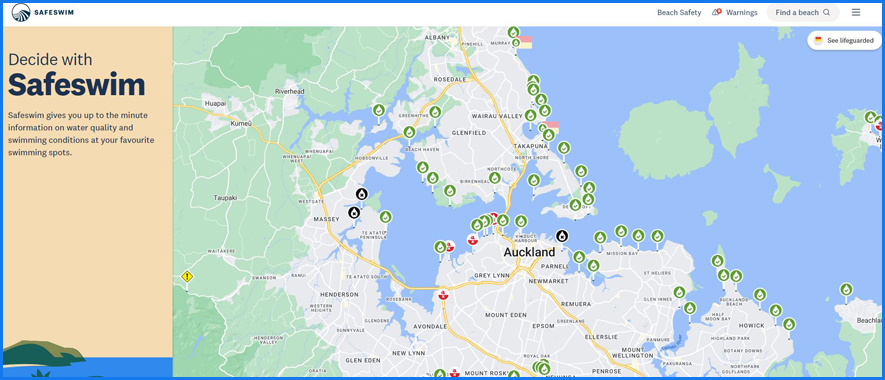
Auckland Council's Safeswim monitoring programme is designed to provide regular assessments of water quality at a range of beaches in the region in an effort to reduce the risk to public health.

Under the programme, dozens of beaches in the Auckland region will be monitored this summer, with water samples collected regularly from the selected locations and then tested for bacteria to identify any potential public health risk.

The results will be available on the latest monitoring pages for beaches and lakes and via 0800 723 379.

If there is a risk to public health, signs will be put up on the beach until the water quality tests is assessed to be safe.

We recommend you:

  • obey any signs warning against swimming,
  • do not swim 48 hours after heavy rain,
  • avoid swimming in high risk areas such as stormwater outfalls and stream mouths.

Note: The Safeswim programme does not undertake to determine if beaches are physically safe for swimming or other recreational use.

On this page:

Locations with current water quality issues
Beaches with a good history
Which beaches are being monitored?
How is water quality assessed?
Responding to incidents
Background Information


Locations with current water quality issues

Ongoing water quality issues have been identified at the locations listed below and swimming and recreational water activities is not recommended in those areas until these issues have been resolved.

Permanent warnings are currently posted at:

  • Cox’s Bay
  • Meola Reef
  • Weymouth Beach
  • Little Oneroa Lagoon
  • Wairau Outlet.

For the latest information on testing results and bathing water quality problems:

See the latest monitoring pages for beaches and lakes or call 0800 723 379.

Back to top


Beaches with a good history

Some beaches have a history of excellent water quality and present a low risk to public health. For this reason the following beaches do not require routine monitoring:

  • Goat Island Marine Reserve, Leigh
  • Anchor Bay, Tawharanui Regional Park
  • Tawharanui
  • Kendall Bay, Birkenhead
  • Cheltenham Beach, Devonport
  • Devonport
  • Sunkist Bay, Beachlands
  • Omana Beach, Omana Regional Park
  • Maraetai
  • Omaha
  • Wenderholm
  • Okoromai Bay

Back to top


Which beaches are being monitored?

Auckland Council has assessed all of the 180+ beaches in the region on their level of use, contamination risk and special significance.

From this assessment 64 beaches have been selected for weekly monitoring at the start of the 2011-2012 season, with the potential for ongoing reviews to result in some changes.

Safeswim monitored beaches map - 2012-2013 season (5.13mb)

Currently water samples are being collected and analysed on a weekly basis in accordance with national guidelines published by the:

  • Ministry for the Environment
  • Ministry of Health.

These guidelines provide levels at which a beach is considered to be safe, unsafe or where re-testing is required. The water is tested for levels of bacteria called Enterococci (in marine water) and E. coli (in freshwater).

Toxic algae are also tested for in the Rodney lakes where a potential problem exists.

Back to top


How is water quality assessed?

The two main methods of assessing water quality and associated public health risks are:

  • Regular water quality monitoring over the summer swimming season
  • Responding to water quality problems where they are identified

Water quality monitoring provides a direct measure of water quality, but is specific to the time and place that the sample was taken (i.e. the information is already at least two days old before the council receives the results).

Response to water quality problems where they are identified means more immediate action can be taken but it relies on knowledge of where and when problems occur.

Back to top


Responding to incidents

Auckland Council responds to pollution incidents to protect public and environmental health.

The events that are most likely to affect bathing beach water quality are:

  • overflows of sewage from the wastewater network
  • significant pollution of the stormwater system.

Processes have been set up across the region to identify, resolve and manage risks to public health. The latter includes putting up signs, warning the community of problems and undertaking water quality testing to identify when water quality has improved.

Please report pollution to Auckland Council’s Pollution Hotline on 09 377 3107

Back to top


Background information

Overall, the water quality in our bathing beaches and lakes is very good and meets New Zealand health guidelines. However, from time to time, water quality problems can arise.

The two main causes of water pollution are stormwater runoff and sewage overflows that may carry pollutants and contaminants into our streams, beaches and lakes.

Water quality problems are identified through regular water quality testing at the beaches and also by responding to pollution problems when they occur.

In 2011 Auckland Council undertook a thorough review of the Safeswim programmes inherited from the legacy councils to provide a more consistant, effective and regionally representative programme.

The review included a thorough assessment of all the beaches in the Auckland region based on four criteria:

  • level of full contact use (e.g. swimming)
  • level of partial contact use (e.g. kayaking)
  • risk of contamination
  • cultural significance.

All sites were assessed against the above criteria and ranked according to the weighted score resulting in a list of beaches where routine monitoring would be most beneficial through to least beneficial. The list was then further rationalised to ensure a regional representation of sites. Selection of sites ranking high on the list ensured water quality will be monitored where the greatest benefit to the public will be gained.

Auckland Council will continue to put up warning signs at beaches when wastewater overflows make them unsafe for recreational use.

While every effort is made to ensure that water quality test results and any identified problems are updated on this site as soon as they are received there are some limitations to the programme. Routine samples are only collected once a week (usually Tuesday) in order for analysis to be undertaken and any issues addressed before the weekend. This means that any changes in the water quality may not be identified until the next sampling day. When sewerage overflows are found to impact on recreational beaches additional sampling is undertaken and warning signs will be erected if necessary.

The 2011-2012 season is a transitional period for Safeswim, with work continuing on an innovative new approach to assessing recreational water quality in Auckland.

Contact our Water Quality Advisors if you have any further queries

Back to top