
Before you chop, prune or trim a tree, check whether it is protected and if you need resource consent. Tree rules can be complex and depend on your site or your neighbour's property.
Tree work rules for your property and neighbouring properties
When a tree on your property is protected
Rules may apply to trees and vegetation on your property depending on where they are and the type of work proposed. A resource consent may be required in some situations.
No class or species of tree has automatic protection where a number of vegetation rules apply (excludes the Hauraki Gulf islands).
Rules can limit or control what work you can carry out on trees and vegetation, including removal, trimming or alteration. For example, vegetation clearance in rural areas may require you to apply for a resource consent, particularly removing larger areas of vegetation.
Visit Working on or around protected trees for more information.
Vegetation clearance on Hauraki Gulf islands
To check if you need a resource consent to remove or alter vegetation on a Hauraki Gulf island, review our District Plan guidance on vegetable clearance.
Reasons your tree might be protected
Notable tree or a tree in a Significant Ecological Area
Use our GeoMaps viewer to check if a tree on your property is a notable tree. You can also find trees that are within a Significant Ecological Area (SEA) area. SEA trees have an additional level of protection.
To search on GeoMaps, enter your property address and the results will display the 'Overlays' on the left-hand side of the screen.
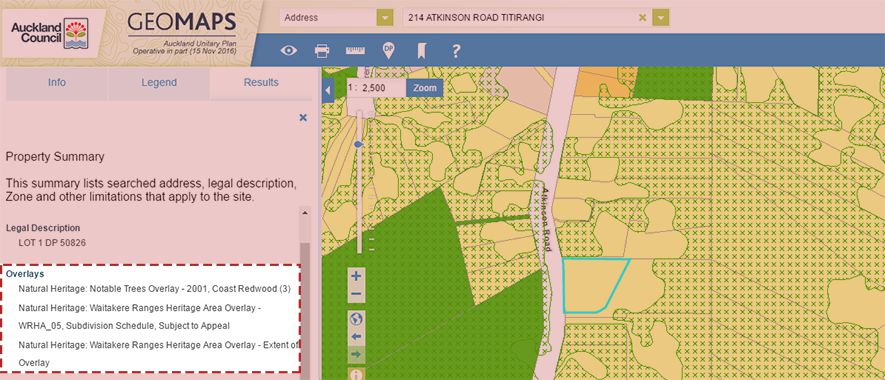
Map view displaying green icons that mark protected trees located on a neighbourhood map in west Auckland.
Tree or vegetation near a body of water
Trees or vegetation (non-pest species) may be subjected to rules if they are located:
- on or near (within 20m) steep coastal cliffs and within 150m of the high tide mark
- on or near (within 20m) stream and river banks
- within or close to sensitive coastal or wetland areas.
Tree protected by a condition on a past resource consent
You can order a property file to find out if a tree is protected under a condition of a previously granted resource consent.
Tree protected by a covenant or a consent notice on a Certificate of Title
Order a Certificate of Title from the Land Information New Zealand (LINZ) to find out if a tree is protected under a consent notice or a covenant on the property title.
Check if you can chop, prune or trim trees on neighbouring properties
Trees can sometimes cause problems for neighbouring properties when they block drains, damage walls and foundations or create hazards.
- If branches or roots from trees on a neighbouring property have crossed your boundary, you may be able to trim them, but you must first check whether any rules or resource consent requirements apply.
- If a tree on a neighbour’s property either diminishes or endangers your life or property, as a final step you can apply for a court order requiring your neighbour to trim or remove the tree.
- If the tree was planted on the boundary, you and your neighbours are co-owners.
- If a problem is caused by a neighbour’s tree, or your tree causes problems for them, talk with your neighbours and try to solve the issue amicably. You can also Report a problem and we will check for you if the tree is protected or council-owned.
You can get advice from:
- Citizens Advice Bureau (CAB) website
- professional arborist
- local Community Law Centre
- your solicitor.
Contact us
For more information about tree rules or when you need a resource consent for work on or around a tree, email enquiry@aucklandcouncil.govt.nz or phone 09 301 0101.