
Outdoor tanks store water for use in many applications, both domestic and commercial.
Before checking whether you need a consent for your rainwater tank, there are a few things you need to think about.
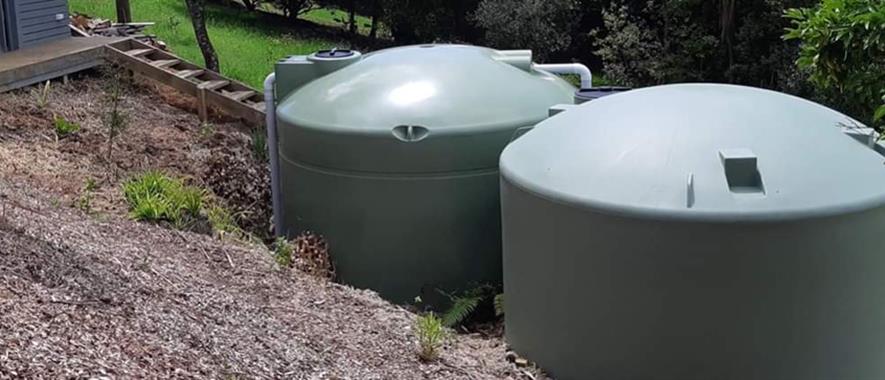
Outdoor tanks store water for use in many applications, both domestic and commercial.
Before checking whether you need a consent for your rainwater tank, there are a few things you need to think about.
To determine the best size rainwater tank to meet your needs, think about:
Use our rainwater tank size calculator but also discuss your specific requirements with tank suppliers and/or an engineer.
You may need a building consent if your tank will be on top of a supporting structure instead of on the ground. The building consent process checks for health and safety requirements under the NZ Building Code, including structural stability.
Whether your proposed tank on a supporting structure needs a building consent depends on the volume of the tank in relation to the height of the structure.
You may not need a building consent for a tank on a supported structure if it meets Exemptions Guidance for Schedule 1 of the Building Act 2004 (PDF 8.9MB) criteria.
If the stormwater drain will be altered to fit a rainwater tank, a licensed registered drainlayer must carry out the work and you will need a building consent, unless the drain alteration is minor.
If you have a detention tank that holds stormwater run-off before slowly releasing it into the public stormwater system or a dual-purpose detention and retention tank, you will need a building consent.
There are two types of consent — resource consent and building consent. You may need one, both or neither of these, depending on the type of tank you have, what it is for and where it is located.
This consent tool is currently unavailable due to maintenance work. In the meantime you can view our rainwater tank standards document (PDF 596KB).
Contact us on 09 301 0101.
Visit your nearest library with council services.
You may not need a building consent if all of the following applies to your tank:
See the Exemptions Guidance for Schedule 1 of the Building Act 2004 (PDF 8.9MB) for more information.
If you plan to connect your rainwater tank to your internal plumbing, you will need a building consent and a licensed registered plumber must carry out the work.
All building work must comply with the Building Code.
All non-potable water outlets and supply pipes (e.g. a garden hose tap) must be clearly identified as not suitable for human consumption by displaying a sign that says ‘non-potable water’ or ‘not for drinking’.
You can find out more about the NZ Building Code Clause for Signs (PDF 786KB).
Resource consents ensure property development zone standards in the Auckland Unitary Plan are met.
Where your rainwater tank is positioned on your property, the size of the tank, and any special environmental and ecological traits of the area and the zone you live in will determine whether you need a resource consent.
An Auckland Unitary Plan Change and a Hauraki Gulf District Plan amendment decision has recently been passed. This may mean, in most cases, your rainwater tank may not require a resource consent.
See Consent requirements for rainwater tanks or email streamlinerc@aucklandcouncil.govt.nz for more information.
To avoid delays in processing your rainwater tank consent application, you should:
Provide evidence of ownership or rights over the property (i.e. record of title). If you are not the owner, provide authorisation to apply for a consent.
The project description must be accurate and describe all work involved in the project.
All drawings and plans need to have:
Freehand sketches are not accepted.
If supported by a producer statement, the plans must also be signed by the design specialist.
Use our lodgement checklist specific to rainwater tanks to ensure you have provided all the relevant information. Incomplete applications will lead to delays.
Rainwater re-use tanks: A rainwater re-use tank, also known as a rainwater retention tank, is used to store rainwater which can then be re-used for gardening, toilet use and laundry purposes. Sometimes, it is referred to as a single-purpose rain tank.
Full water supply tanks: If your proposed rainwater tank is to be used for your entire water supply (including drinking water), please contact our building consent help desk.
You will need to provide:
There are also zoning considerations that may bring additional design guidelines, which may require a resource consent.
This applies if you are installing a tank in a Special Character Overlay Area, the Hauraki Gulf islands or in a Historic Heritage Overlay Area.
We recommend you engage a professional to complete your application form.
You will need to:
We only accept online applications for this service. If you are unable to apply digitally, visit one of our libraries with council services for assistance in making your online application.
Call us on 09 301 0101 to speak with our building and planning help desk if you have questions regarding your application.
See Free advice before submitting a consent application for more information.
The consent fee depends on the value and complexity of your project.
There are separate fees for resource and building consents.
For building consent fees, see Building control fees and charges.
Email streamlinerc@aucklandcouncil.govt.nz with your completed Form A (PDF 693KB).
We will process your application within 10 to 20 working days.
We will let you know the decision by email or post.
If your application is not complete, we will return it to you with a request for the missing information. You may need to pay fees.
The owner/occupier of the premises must ensure the water tank is maintained in good operating order and the water is in satisfactory condition.
Find out more at Rainwater tank components and maintenance.